Sunday, October 28, 2007

New Pictures / New Camera

I've posted some pictures (link below) from a fun walk Amy and I did yesterday on the South Side Slopes (thanks to Brian and Sarah for the idea). This is the second outing where I've used my new small camera, a Ricoh GX100 (the first was my Olympics Trip with Stewart). I wanted to replace my older Canon S400 with another pocket camera with better image quality and a wider-angle lens; I still have my Canon 10D for dedicated photography trips, but it's heavy and impossible to use with one hand, making it poorly suited for light-and-fast backpacking trips, photography while climbing, and random outings where I probably won't take pictures but might if something interesting comes up. The compact digital camera market still has relatively few offerings with a wide-angle lens, good manual controls, and quality optics. I'm particularly disappointed in Canon; it seems clear that they are trying to force "serious" photographers into their DSLR line. And everyone is using small sensors with too many pixels, leading to poor low-light performance. It's frustrating. I considered the Panasonic LX2, but dismissed it due to especially poor high-ISO noise. I've been pretty happy with my S400, so I looked at the newer SD800 (a very similar camera, updated with image stabilization and a wider lens), and the Ricoh Gx100. The Ricoh is about twice the price, so before committing I ordered both cameras from Adorama, and spent a few days walking around taking comparison shots. The Ricoh won out thanks to notably better optics and excellent manual controls. In particular, the gx100 had much better edge sharpness at the wide end and much better control of chromatic aberration. The manual controls are natural to someone coming from a DSLR, and the customizability is great (for example, I can store 2-second self timer / ISO 80 / no image stabilization as a custom setting on the mode dial to quickly switch to my preferred tripod settings -- I wish I could do that on my 10D). An added bonus is the outstanding macro capability on the GX100, far superior to the Canon. For examples, look here, here, and here. The capabilities of the camera are complemented nicely by a flexible mini-tripod (I have this one). The camera still fits in my chest pocket with the tripod attached, and the small size of the camera makes it much easier to maneuver for macros than a full DSLR setup. Many of the landscape shots I've taken so far have also been with this tripod.
South Side Slopes

Sunday, October 21, 2007

Olympics Ridge Traverse

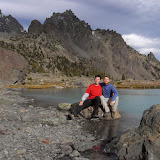
I visited Seattle in early October, and Stewart and I were lucky enough to get three days of beautiful weather in the Olympics for a fun traverse of the the Petunia Peak Ridge. Pictures are now on Picasa, and topozone has a map of the area (link centered on Goat Lake).

Olympics Ridge Traverse

Saturday, August 25, 2007

Questions for an alpine rock climb

Amy and my trip to Tuolumne this past June got me thinking about ways to improve my abilities on alpine rock. This led to the following bit of writing, which I'm finally getting around to posting here: Questions for an alpine rock climb Competency in the fundamental skills of technical climbing and mountain travel are pre-requisites for success on alpine rock, and books like "Freedom of the Hills" do an excellent job of illustrating them. But these skills are only the basic ingredients; it is the art of selecting and combining them that often separates success and failure in the mountains. While much of the art of alpine decision making can only be learned through experience, maintaining a full awareness of the situation is a necessary first step. Often, the key to awareness is asking oneself the right questions. With this in mind, I have tried to compile a "cheat sheet" of important questions. Masters of the craft probably never ask such questions of themselves consciously, as habit blurs the questions and their answers into a continuous flow of thought guiding movement. But as an intermediate climber striving to improve, I found it useful to write down an explicit list. Many of these questions are here because experience has taught me some consequences of not asking them; others, because experience has shown me some of the benefits. This is far from a complete list, and I welcome suggestions and discussion.

When Preparing for a Climb

  • Do I have the appropriate gear (including maps and topos), and do I know how to use it?
  • What are the expected conditions? What is the weather forecast?
  • Have I talked with my partner extensively about the climb? Do we agree about our goals? about gear choices? about scenarios that would warrant retreat?
  • Do we have a system in place in the event we can't communicate after someone leads a pitch? What if the rope gets stuck in the middle and we can't communicate? If someone gets injured?

During the Whole Climb

  • Am I staying hydrated? Am I eating enough? Am I managing my temperature so I'm not too hot, not too cold, and not sweating too much?
  • How is the altitude affecting my partner and I? (Thanks to Dan).
  • How are my mental and physical strength holding up? Have I asked the same questions about my partner? And asked explicitly if I have any concerns?
  • Are we moving faster or slower than expected? How is the weather developing? How much daylight is left? Do we need to consider retreat, a bivy, or a change of route?
  • What are the biggest risks we are currently facing: rockfall or icefall? weather? slipping while unroped? leader fall on runnout terrain? making a rappel mistake? hypothermia?
  • Am I asking these questions out-loud? Does that mean my partner now thinks I'm crazy? And if so, does that help or hurt our chances?

When Approaching a Climb

  • Can I see the route? Can I see the descent? Have I compared these to the maps/topos I have? Am I scoping out bail routes and possible bivy sites as well as the main route?
  • If the descent is the same as the approach, am I turning around frequently to see what it looks like going the other way? Am I making mental notes of critical junctures? Will I be able to retrace this route in the dark? Am I on the lookout for water sources we can use during the climb?

At the Base of the Climb

  • Have we double-checked our gear, water, and food?
  • Do I have my helmet on? How do the route conditions look up close? Is there snow or ice that presents a hazard? (also from Dan).
  • Is my harness on correctly, and am I tied securely into the rope? What about my partner?
  • Have we decided who is going to lead what? Do we need to finalize a turn-around time?

When Building a Belay

  • What protection is available here? Is it adequate? Should I downclimb to a better belay (a comfortable belay ledge can lead to a much faster transition than an awkward hanging belay)? Should I climb on (possibly simul-climbing?) to a better belay?
  • How should I rig the belay? What is the most comfortable stance that will allow me to belay efficiently and contribute to the strength of the anchor (especially if gear isn't totally bomber)?
  • Where will the second clip in and belay from? (esp. if leading in blocks, how will the second efficiently transition to a good, anchored belay?)

Before Leading a Pitch

  • Have I surveyed the pitch? Have I visualized and mentally prepared?
  • Leading a trad pitch (esp. alpine) can present at least three types of challenges: the actual climbing, protecting the climbing, and route-finding. Have I gathered information about all three of these from the belay?
  • Have I looked at the topo and thought about where the next belay will be?
  • Is the climbing immediately above the belay easy? Is it possible I will want my belayer to simul-climb if I run out of rope on this pitch? Have we communicated about this?
  • Generally, have I answered as many of the "when on lead" questions (see below) from the belay as possible?
When on Lead
  • Where is my next protection opportunity?
  • How run out am I? Is there ground/ledge fall potential?
  • Am I placing protection to protect myself and my follower on traverses (a 20' fall on a traverse away from a corner can be worse than a 20' lead fall to a ledge, because the impact with the corner will be a blow to the side of the body, instead of to the feet and legs).
  • Am I planning ahead for protection, route-finding, and the climbing?
  • Am I staying calm, breathing smoothly, and making precise movements? Am I over-gripping?
  • Is the rope running smoothly and straight? Are there sharp edges, constrictions, horns, or other features that could snag or cut the rope (be particularly wary of sharp inverted-V slots behind flakes that can snag a rope). Are there loose rocks that the rope could dislodge if not routed carefully?

When Rappelling

  • Should the ropes be thrown, or flaked on a sling and carried by the first person?
  • Do I know what my next rappel looks like? Do my ropes reach that point? What are my options if they don't? (also from Dan).
  • Even if two ropes are available, should a double or single rope rappel be performed? What is the best knot to join the ropes? Which end of the rope are we pulling? Are there obstacles that could snag the rope when it is pulled? Are there loose rocks that could be dislodged?
  • Is the anchor solid? Have fixed gear or slings been carefully inspected? Have they been backed up for the first person? Is the rock or tree the anchor is based on solid? Is the rope threaded correctly, with the middle of the rope at the anchor? Is my belay device correctly attached to the rope and my harness with a locking biner? Is my harness still properly secured (doubled-back, etc)?
  • Are there knots in the end of the rope? Is a rappel backup needed? (An auto-block for the first person can save significant time if it lets them more efficiently untangle a snagged rope.) Should the belay device be extended? Is a chest harness needed?
  • When on the ground: What is the best direction to pull the rope?

Reasons to go back to Squamish

I was in Vancouver for a conference in July, and so I went up to Squamish a few days beforehand to climb. It rained the whole time, unfortuantely, so I didn't get any actual climbing done. I did walk around the base of the Chief to check out some interesting routes for next time. They start at the campground wall, and can all be reached by just following the trail along the base of the Chief, working north towards the Apron. It's probably 20 minutes of walking to cover the whole distance, though I took about an hour and a half with stops to admire the fine lines, check the guidebook, etc. I didn't take any pictures, but I found some shots online that I've linked below. Slot Machine (5.9) I didn't actually scramble up to look at this, but it looks really good from the picture. Maybe a good warm up for some of the others. A Pitch In Time 5.10b Looks good, short, good pro, steep for the grade. Rainy Day Dream Away 5.10c Don't remember this too clearly, but I think it looked pretty do-able with good pro. Slightly less than vertical. Arrowroot (10b) Looks really great, excellent pro. Rutabaga (11a/10b) Right next to arrowroot. The first pitch has chains and is 10b. Looks excellent. The broken crack at the bottom means pro a little more limited than arrowroot. Apron Strings 5.10b Sustained 10b liebacking. Exasperator 5.10c Good pics: Exasperator Two (short) pitches, .10a then .10c. Probably the right thing to do is link them with a 60m rope. Looks really, really good. Great pro. Seasoned in the Sun 5.10b Good Pic: Seasoned in the Sun Just another mega-classic, great pro perfect splitter face crack.

Sunday, July 29, 2007

Tuolumne Pictures

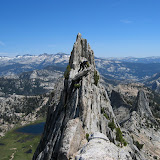
Tuolumne pictures are now on Picasa. Climbing and hiking including Cathedral Peak (Southeast Buttress), Eichorn's Pinnacle (North Face), Matthes Crest (partial traverse from South to North), Stately Pleasure Dome (West Country), backpacking to Young Lakes, and Tenaya Peak (Northwest Buttress).

Tuolumne Meadows, June 2007

Sunday, April 15, 2007

Pictures from Darjeeling

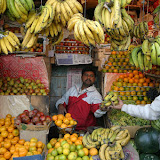
Exactly a year ago today I arrived in Darjeeling, India, so I guess it's about time for me to post some pictures. Trying to take photography "seriously" seems to have greatly increased the latency in actually doing anything with my pictures. I took some of my favorite photographs from my whole India trip during my 4 days in Darjeeling. It's a small enough place that after a few days of wandering around I felt like I started to get to know it --- at least more so than with the other cities I visited in India. Three themes in particular captured my attention: the challenges of getting water to a hill town, the spectacular flowers, and the bountiful markets. Darjeeling is perched on the crest of a hill that rises thousands of feet above the surrounding valleys, and the people of Darjeeling have demonstrated extraordinary creativity in finding ways to bring water to their homes. There are brilliantly painted heavy-duty water tankers, old pickups with cisterns or tanks strapped to the back and sagging with the weight, braided conglomerations of small-gauge water pipe running on the ground or even hung like power lines between buildings, and hand-carts loaded down with huge water jugs. The one thing I didn't see was any kind of centrally-controlled municipal water supply or pumping system. I was also inspired by the prevalence of growing things, especially flowers. It seemed that every porch and banister and window of every house was lined with beautiful, overflowing potted flowers and other plants. There were even cages on the sides of buildings in the city where people would grow their flowers, padlocked behind chicken-wire-screened doors. No visitor or photographer should miss the markets and street vendors. Stalls piled high with grains, fruit, vegetables, spices, dried fish, not to mention every grade and preparation of Darjeeling tea imaginable. I visited some of the touristy sites, but my favorite memories are of strolling along the back roads and through the markets, pausing frequently to sit back and observe the colorful, unfiltered, and vivid life of this city.

Darjeeling and vicinity

Saturday, March 31, 2007

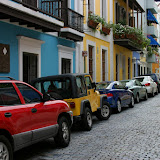
I've posted some pictures from my recent trip to Puerto Rico for AISTATS and the Learning Workshop.

Puerto Rico